Starting point

AI needs to solve a specific problem in your business. Otherwise, it is just another subscription.

More tools appear every month, each promising to save time. None of them knows your process from a customer's first call to the final invoice.

So we start with your working day: where things stop, where the same information is entered twice, and where an enquiry goes unanswered.

Only then does a conversation about tools make sense.

A business owner sits alone at a desk in a bright office, hand on chin, thinking over a stack of paper proposals, with a phone and closed laptop nearby

Three outcomes

Where does AI actually make a difference in a business?

In practice, everything AI does for a small business falls into one of three areas. Each has its own examples and limits.

More enquiries

The aim is for customers to find you when they are searching, and for replies not to wait until tomorrow. A system can respond to an enquiry immediately and record it in one place. Content prepared to your instructions can be published regularly, without manual work.


More from existing customers

For a customer who has already bought from you, the path to the next project is shorter. A system can request a review after a service or follow up on an unanswered proposal. It can connect your data so you can see who has not been in touch for a while.

Less repetitive work

The same cycle repeats every week: copying data, preparing proposals, issuing invoices and organising documents. A system can complete the preparation, leaving you to review and approve. Work that follows the same rule can be handed over to it.

Every project we take on targets one of these three outcomes. We agree which one before starting.

Process

From a free call to the first working solution.

Each step is small and ends with something you can read or try. The next step begins only after your approval.

  1. Free call, 30 minutes

    Tell us where things get stuck and what you want to change. During the call, we assess whether AI is the right approach and what a sensible first step would be.

    The call is free and carries no obligation.

  2. Consultation: a review of your business

    Together, we go through your work in order, from the first customer contact to the invoice. We look for wasted time and sources of errors. You receive written findings and a proposal for the first step.

    Scope: one review and written findings. You decide what follows.

  3. First project: one thing, done properly

    We take one thing and bring it into everyday use. Before development starts, we agree what to measure, where that number stands today and where we want it to be by the agreed deadline.

    Scope: one project, one goal, an agreed deadline.

  4. Ongoing work: expand what works

    Once the first step is running, we move to the next. You set the priorities. We make sure it connects to what is already in place.

    Scope: monthly, without a long-term commitment.

Sometimes AI is not the answer. A simpler process or one rule in a tool you already use may be enough. When that is the case, we say so.

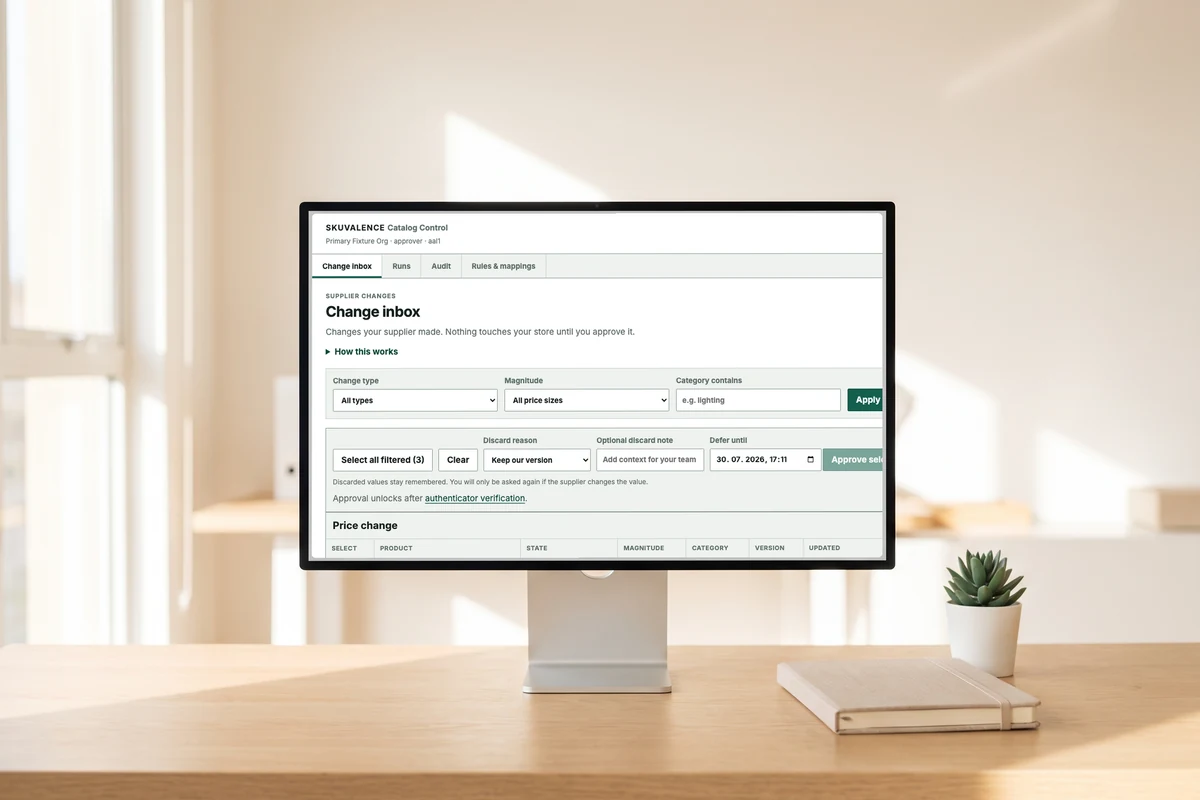
Hands at a keyboard with Skuvalence Catalog Control showing supplier catalogue changes, notes, sticky notes and coffee on a sunny desk

Background

I run my own business with an AI system I built myself.

Every morning, the system checks my inbox and shows what needs a reply. It prepares complete proposals and invoices using my details and my usual formats; I read and approve them. No message or document goes out without me.

Before client work, it gathers the background and cites sources for me to check. It also remembers what was agreed on each project, even months ago, so I do not have to search through emails and old notes.

I trained as an engineer and spent years working with data systems. When I started STANCICH.AI, I applied the same approach to my own work.

I use what I recommend to you in my own business first.

References

What is already running in the real world?

Four examples from the past year. Two run for iHunt (STF d.o.o.), one for Profist, and the fourth is for independent service providers.

Who it is for

Who is AI consulting right for?

It works well for established businesses with enough work for tasks to start repeating. We also list the situations where we will not be able to help.

A good fit for you

  • The owner still does everythingProposals, invoices, customer replies and work organisation all go through the same person. This is where the first savings become visible.
  • Lots of repetitive administrationThe same data is copied between email, spreadsheets and accounting. Tasks with clear rules can be handled by a system.
  • The business is already runningYou have customers, enquiries and data. The system builds on what you already have, without requiring a fresh start.
  • Ready for a small first stepThe first project is deliberately small. We discuss the next one only once it works.

When we cannot help

  • If you want one button that solves everythingThere is no such button. Every system needs your data, your rules and some of your time at the start.
  • If the main goal is simply to have AIIf there is no specific goal behind a project, we identify that quickly on the call and do not sell you the project.
  • If access to data is not possibleA system can work only with what you give it. Without access to your processes and data, we cannot promise a result.

Websites

When your online presence is the answer.

For many businesses, the first step turns out to be the website: that is where enquiries arrive and customers receive their first reply. In that case, our other service—smart websites—is the right place to start. It is the same approach, delivered as a product.

Explore smart websites

Questions

Common questions before the first call.

Why is there no price list on the website?

Every business is different, so a number without a conversation would be a guess. The scope depends on what you already have, how your data is organised and what you want to achieve. The first call is free. Afterwards, you receive a written proposal with a specific scope, deadline and price; for larger cases, we suggest a consultation first.

Where does our data stay, and who can see it?

It depends on the solution. Where possible, data stays in your existing tools and within an EU-based environment. Before starting, we document which data the system accesses, where it is stored and who has access. We use your data only for your system.

What if AI turns out not to be the right solution to our problem?

You receive written findings and a recommendation for what would make sense instead—even if that means changing a process or making better use of a tool you already pay for. The business review remains useful regardless of who takes it forward.

Which languages do you work in?

Slovenian, Italian and English. The systems we develop can work in several languages at once, so your customers write in theirs and you read in yours.

How soon can we start?

We can usually arrange a call within a few days. The consultation and written findings follow within a week or two, depending on how many processes we review. The first project is deliberately small, so it is measured in weeks. We put the exact deadline in the proposal before starting.

Contact

Let's see where we
could start.

On a free half-hour call, tell us what is getting in the way. You leave with our view of a sensible first step, even if you choose not to work with us.