


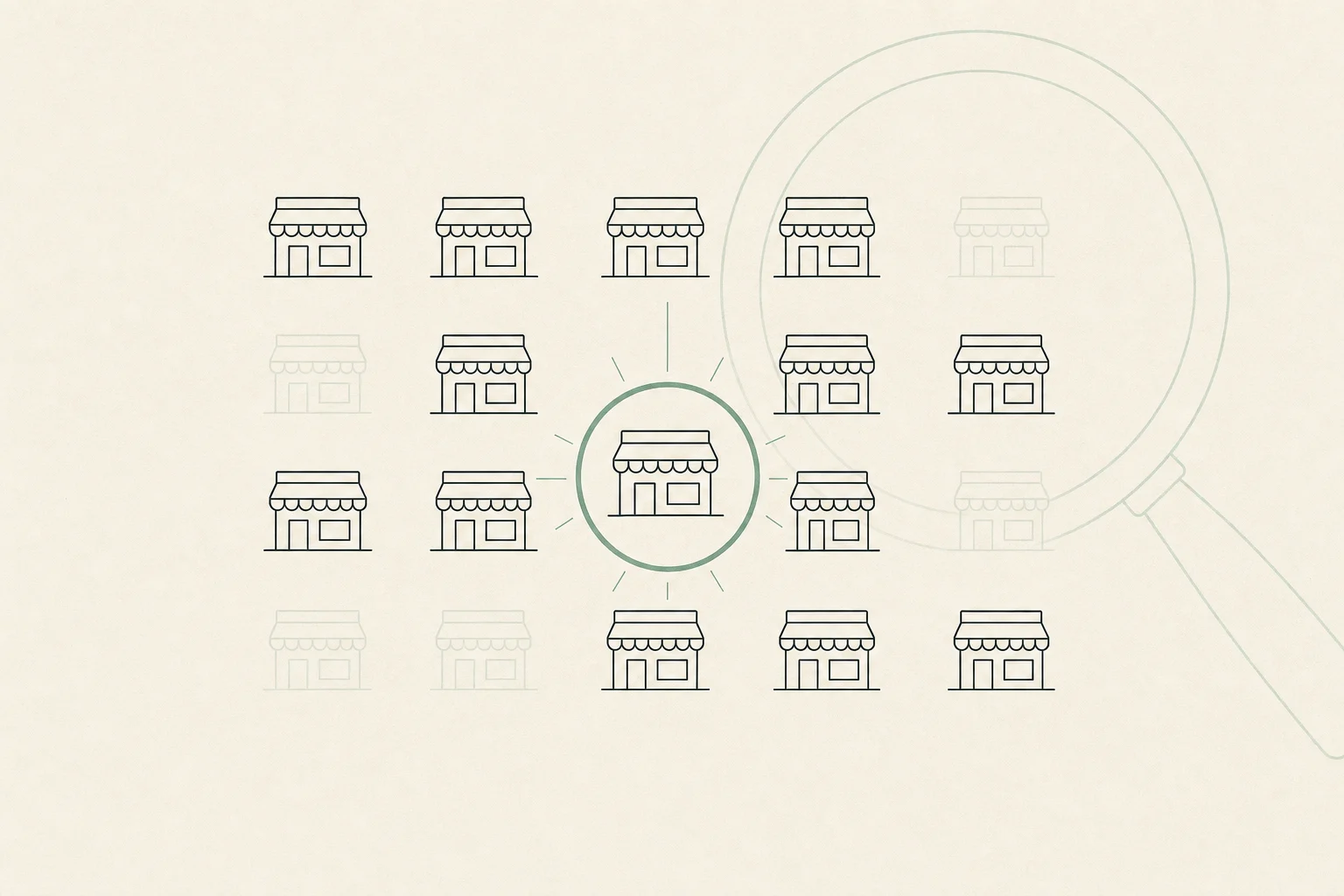
We took 20 Slovenian businesses from the first page of Google and asked three AI search engines the question their customers type: "who do you recommend". A third of the businesses were not mentioned by any engine, even though AI knows all of them and describes them accurately when you ask directly. The difference is not in the data, but in the sources AI reads: directories, business registries and Google profiles with reviews. Below are all the numbers from 89 queries, run on 12 June 2026.
An electrician near Maribor has 4.8 stars on Google. His website works, his profiles on trade directories are live, and in the search results he looks like a safe choice.
When we asked ChatGPT whether it would recommend him, it answered that it does not recommend the company because, according to public registries, it has been deregistered. Google AI said the same. We checked the business registry: both were right. The company was wound up at the end of 2024. Its digital shadow, a profile with 4.8 stars and a working website, keeps quietly collecting visitors to this day.
This was not an isolated case. It was just the strangest result of a study we ran in June 2026.
What we did
We picked 20 Slovenian businesses from 10 trades our clients actually search for: plumbers, air conditioning installers, electricians, accounting firms, car mechanics, hair salons, carpenters, construction companies, dentists and restaurants. Two businesses per trade, from six cities.
One important selection rule: all of them are winners of classic Google. Each shows up on the first page for its trade and city, has its own website and a Google Business Profile. In other words, businesses that have "already done their SEO".
We then asked three AI search engines (ChatGPT, Google AI Mode, Perplexity) two kinds of questions, the kind a real customer types. First: who do you recommend in this city for this service. Second: what can you tell me about this specific company. 89 queries in total, all on 12 June 2026, in Slovenian.
Number 1: a third of the businesses do not exist for AI
When a customer asks "who do you recommend", ChatGPT mentions 6 of the 20 businesses. Google AI, which has direct access to Google's data, mentions 13 of 20.
Six businesses (30%) were not mentioned by any engine we tested. Not once. These are first-page Google businesses with ratings between 4.6 and 5.0.
Only two businesses out of twenty were visible everywhere. Both share the same combination: a high rating on their Google Business Profile, enough reviews, and a profile that links to their own website.
The differences between engines are large, so they are worth looking at separately:
| Engine | Recommended (of 20) | What it draws on | What it means for you |
|---|---|---|---|
| ChatGPT | 6 (30%) | Business registries and credit ratings (Bizi, CompanyWall), then directories | Judges from the registry. A fresh entry or a poor rating drops you fast. |
| Google AI Mode | 13 (65%) | Google Business Profiles, own sites, everything else | The most generous, yet even here a third of businesses fall out. Review volume decides. |
| Perplexity | 4 of 9 (44%, partial) | Directories, own sites, FB groups, forums | The densest citing, but free access closes after just 9 queries. |
Number 2: AI knows you, it just does not recommend you
Here comes the most interesting part. When we asked about the same businesses directly ("what can you tell me about company X"), both engines described all 20 correctly. Address, phone, founding year, services, for some even revenue and credit rating.
A business that AI does not mention with a single word in its recommendations, the same AI can describe in detail a minute later, and often even praise.
So data is not the problem. AI already knows everything about you. The problem is that it does not pick you at recommendation time, because its sources do not lead it to you. That gap between "knowing" and "recommending" is exactly what we close when we use AI assistants to fix a business's data where AI actually reads it.
Number 3: for a quarter of the businesses, AI got something wrong
For 5 of 20 businesses we recorded at least one misleading or incorrect fact. A few examples, without names:
An established plumber with years of experience was described by ChatGPT as a "micro business with around one employee, capacity not comparable". The reason: last year the company switched from an s.p. (a Slovenian sole trader) to a d.o.o. (the Slovenian equivalent of an LLC), and the registry shows a fresh entry. Technically true, unfair in substance.
An air conditioning installer with a 5.0 rating and 40 Google reviews was said by ChatGPT to have "few public reviews" and to be a "relatively new company". It was reading the registries and never saw the Google reviews.
For one Maribor company, the engines contradicted each other on the same day: Google AI "definitely recommends" it, while ChatGPT advises caution over a B credit rating and a history of account freezes it found on a financial portal. Two AIs, two truths, depending on which sources they read.
Asked about an apartment renovation, one engine recommended a company with a 3.5 rating and two reviews, because it has the word "prenova" (renovation) in its name. The best-rated company in town for that work (5.0 and 34 reviews) was not mentioned.
And for a Ljubljana plumber, all three engines also recommended an anonymous website with no legal entity listed, just an address and a 24/7 phone number. The real tradesmen from the first page of Google: unmentioned.
Why this happens
We counted the sources across all 89 answers. 464 citations in total. The picture is clear:
| Source type | Share | Most frequent examples |
|---|---|---|
| Directories and lead platforms | ~38% | Mojmojster (40 citations), Primerjam.si (34), Moja dejavnost (21), Omisli.si (19) |
| Companies' own websites | ~35% | sites with a well-kept profile cited several times, others not at all |
| Business registries and credit | 9% | Bizi (16), CompanyWall (15), eBonitete |
| Social | 5% | Facebook (16, including FB groups), Instagram (7) |
The biggest share goes to directories and lead platforms: Mojmojster (a local tradesman directory), Primerjam.si (a Slovenian quote comparison site), Moja dejavnost and Omisli.si. AI engines trust these sites more than the businesses themselves. Twice, Perplexity recommended the directory itself as the answer.
The second group is business registries and credit rating portals: Bizi and CompanyWall (Slovenian company registries) and eBonitete (a Slovenian credit rating portal). ChatGPT in particular leans on them to judge "whether to trust this company". If anything in the registry looks odd (a fresh entry, a poor rating, a deregistration), it flows straight into the answer the customer reads.
Company websites make up about a third of the citations, but with big differences between businesses: those with a well-kept profile and site get cited several times in the same answer, others not at all.
Google itself says you need no special tricks for AI features, because AI answers run on the same index and the same quality signals as regular search [3]. Our data confirms this, with one note: the bar has moved from "having a website" to "having consistent data everywhere AI reads".
How do I check what AI says about my business?
Ask ChatGPT and Google AI two things: "what can you tell me about [your company name]" and "who do you recommend for [your service] in [your city]". This is the mirror your customers are already looking into. If it describes you on the first question but does not mention you on the second, you are exactly in the gap from Number 2.
Where should my Google Business Profile point?
To your own website, not to a directory. Open your Google Business Profile and check the "website" field. For two of the twenty businesses in our sample, the profile pointed to a directory instead of their own site. Both were among the invisible ones.
How many Google reviews do I need for AI to recommend me?
There is no exact threshold, but the direction is clear. In our data, review volume was the strongest single factor: a business with 40 reviews was visible everywhere, a business with 7 reviews nowhere. Ask happy customers for a Google review: it is the cheapest step with the biggest effect.
What should I do if I changed my legal form?
Look at what Bizi, CompanyWall and eBonitete say about you. That is where AI reads your "ID card". If you recently changed legal form, let your website tell that story (for example "with you since 2008, since 2025 as a d.o.o."), otherwise AI reads it as a "new company".
Do I really have to deal with directories?
At least checking them is worth it. Check your profiles on Mojmojster and Primerjam.si. Even if you do not want leads through them, AI takes its data about you from there, and that often decides whether it mentions you at all.
If you want us to measure this for you
We can run this exact study for your business and your competitors: where you stand in Google and in AI answers, which sources drive the answers in your niche, and what to fix first. It starts with a free half-hour call. You can see how we work on the page about visibility in Google and AI answers. The quick-wins list is something you can do yourself.
Limits of the study
Cards on the table: the sample is 20 businesses, enough to show patterns, not statistics. All queries ran on a single day, and AI answers change weekly. Each question was asked once, with no repeats. ChatGPT ran in a temporary chat on the default model, Google AI and Perplexity on logged-in accounts (Perplexity visibly tailored two answers to the user's profile, a warning in itself). After 9 queries, Perplexity cut off our free access for the day, which is itself a data point about what an average user really gets. We do not name the businesses because we did not want to single anyone out; every example comes from real answers, kept in the study archive.